Introduction
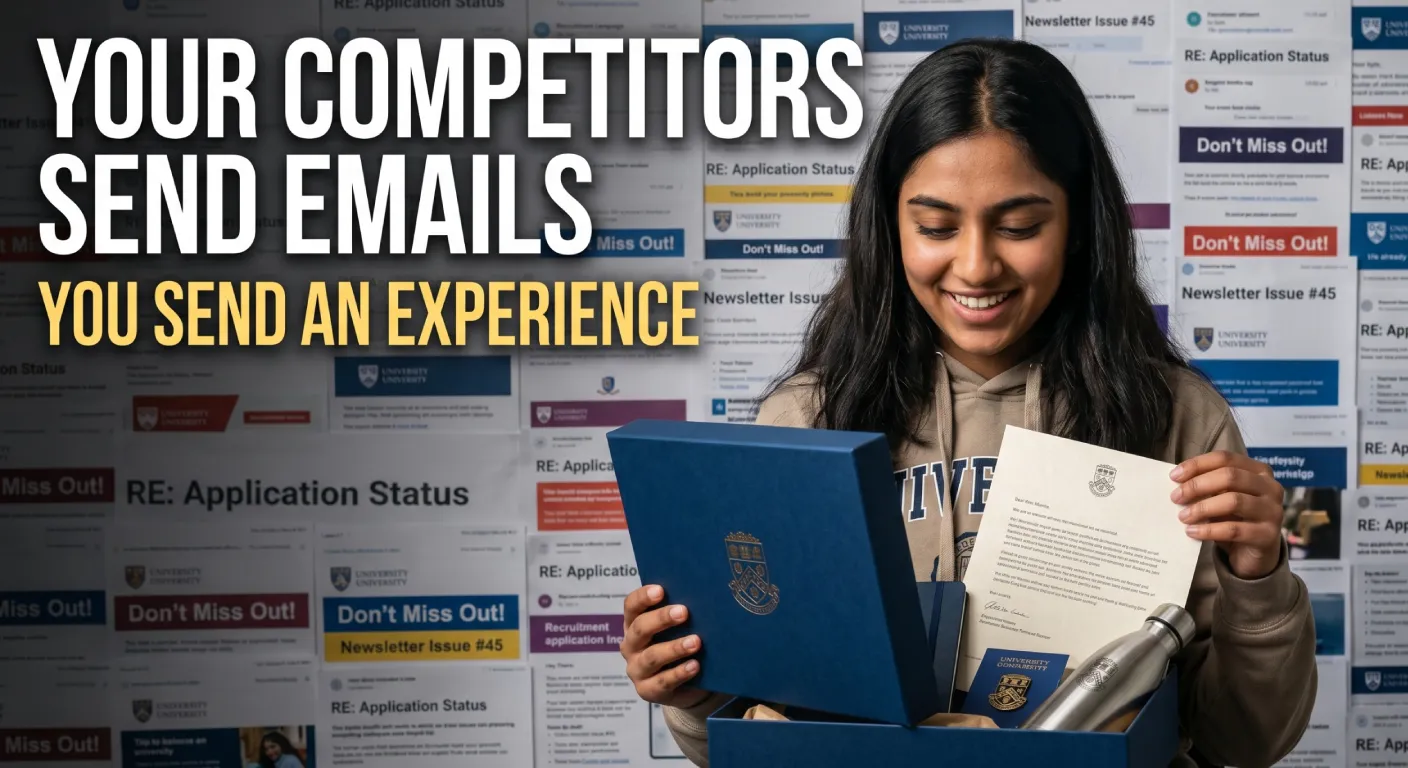
In a crowded inbox, a physical university welcome package isn’t just nice to have. It’s the only message that gets through.
Open your email right now and count how many unread messages you have. For most people, that number is uncomfortably large. For a prospective international student — receiving communications from every university they’ve ever expressed interest in — it can feel overwhelming.
Nobody reads all of it. People scan, filter, archive. They’re not being rude; they’re surviving.
Now imagine a university package arriving at a student’s home. Addressed to them. Containing real things — a printed guide, a branded notebook, a personal note. That gets opened. That gets shared with a parent. That stays on a desk.
“Physical engagement creates stronger recall than another email campaign. Full stop.”
What “brand recall” actually means in student recruitment
Brand recall in a recruitment context is simple: when a student sits down to make their final decision between two or three universities, which name comes to mind with the most positive emotional association?
It’s not usually the one with the best programme content, or even the best scholarship offer. It’s the one that made them feel something. Universities that have been present not just in a student’s inbox, but in their physical world, have a meaningful advantage at that final moment.
A hoodie they’ve been wearing for three months. A notebook they use every day. A welcome letter their mum kept on the fridge. These are not marketing artifacts — they are emotional anchors.
Three stages, three opportunities to be different
Inquiry stage — before the application. Stand out from the digital noise with a kit that arrives at home and says: we’re serious about you.
Applicant stage — during the wait. Keep your university emotionally present while the student waits for decisions from multiple institutions.
Offer holder stage — at the moment of decision. A welcome package that makes the student feel like they already belong — before they’ve even accepted.
What separates a good kit from a great one
The difference between a forgettable branded package and one that genuinely converts comes down to three things: personalisation, quality, and timing.
Personalisation means the student’s name appears on the package and at least one item inside. It signals individual attention. Quality means the physical items are things the student would actually use and keep — not promotional filler that goes in a drawer. Timing means the kit arrives when the student is emotionally available: within days of an event, or shortly after an offer is made.
Hue Marcom manages all three. Our variable data printing capability allows for name-personalised items at scale. Our merchandise sourcing is quality-first. And our fulfilment infrastructure is built for the tight timing windows that recruitment campaigns require.
The cost argument, honestly
Physical kits cost more per unit than emails. That’s simply true. But the comparison is wrong. The right comparison is: what is the cost of a physical kit per enrolled student, versus the cost of not converting a warm lead?
When you factor in the cost of generating a new enquiry to replace a lost conversion — advertising, events, agent commissions — a well-designed physical kit at Stage 3 is almost always the more cost-effective intervention.
The universities that understand this are already acting on it. The ones that don’t will keep asking why their CRM is full of contacts who never enrolled.