Introduction
A look at how Indian companies are rethinking festive rewards this year — from personalization at scale to usability-first gift selection.
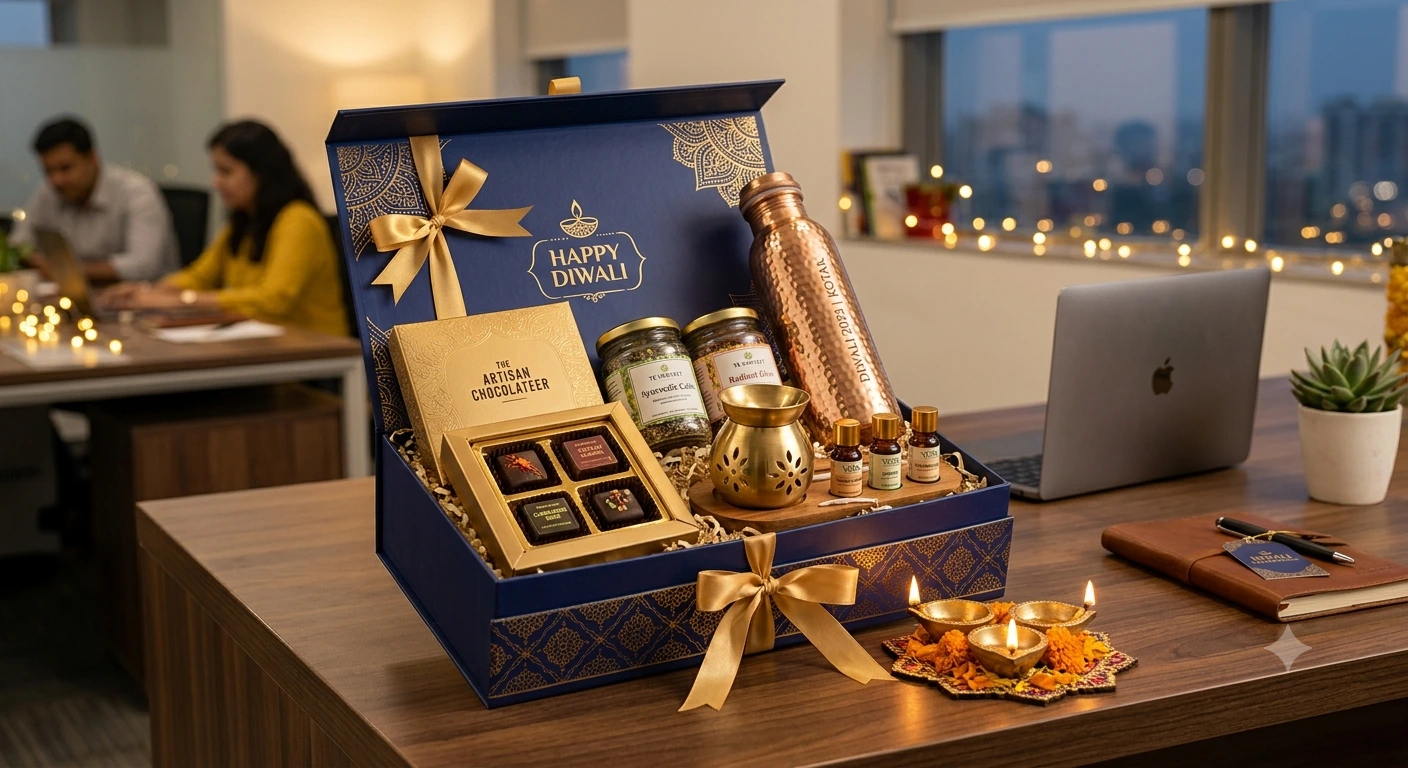
Diwali 2026 falls on Sunday, November 8 — and for HR and procurement teams across India, the annual employee gifting decision has already started looking different this year. The instinct to default to a standard sweets box or a generic branded diary is fading fast, replaced by a more deliberate question: what will employees actually use, and what will the gift communicate about how the company sees them?
That shift isn’t happening in isolation. India’s corporate gifting market is now worth an estimated ₹12,000 crore and continues to grow at a fast clip year over year, and organized, salaried employment — the core audience for corporate gifting programs — reached roughly 23.6% of India’s workforce in 2025. As that base grows and becomes more distributed across cities, the gifting program itself has had to grow up.
1. Personalization Is Moving From Nice-to-Have to Default
Across multiple 2026 industry reports, personalization comes up as the single most repeated theme in corporate Diwali gifting — engraved office items, personalized message cards, and curated gift selections are becoming standard rather than premium add-ons. The reasoning is straightforward: a logo on a product builds brand visibility, but a name, a message, or a choice built around the individual builds an emotional connection a generic hamper can’t.
2. Digital-First, Platform-Led Execution Is Replacing Manual Coordination
Manually coordinating vendors, sizes, addresses, and budgets across hundreds or thousands of employees breaks down fast at scale, which is why gifting programs are shifting toward technology-enabled platforms that give HR memorable experiences, Finance budget visibility, and Procurement a scalable process — all from a single system rather than a spreadsheet passed between departments.
3. Employee Choice Is Replacing the One-Size-Fits-All Hamper
Letting employees pick from a curated set of options — rather than shipping the same box to every desk — has become one of the clearest markers of a modern gifting program. It solves a real problem: a dry fruit hamper that delights one employee may sit untouched on another’s desk, and a single fixed gift can’t account for dietary preferences, regional taste differences, or household needs.
4. Sustainability Has Moved From Optional to Expected
Eco-friendly packaging and reusable boxes are now treated as a baseline expectation rather than a differentiator, with biodegradable materials, kraft paper, and reduced single-use plastic increasingly standard across the India gift packaging market. Several 2026 gifting guides also point to a parallel rise in local-artisan and heritage-craft products, positioned as both more sustainable and more distinctive than mass-produced imports.
5. Distributed Workforces Are Forcing a Logistics Rethink
Post-2020 hiring patterns mean most mid-size and large Indian companies now have employees spread across a dozen or more cities rather than one head office. Shipping address-level hampers to hundreds of individual addresses across thousands of pin codes is a fundamentally different operational problem than handing out boxes at a single office reception — and it’s reshaping which vendors and platforms companies choose to work with.
6. Measurement Is Catching Up to the Spend
A trend that’s easy to miss: companies are starting to actually track what happens after the gift goes out. Redemption rates, participation, and category preferences are being used to plan next year’s program, rather than repeating the same hamper on instinct — a meaningful shift from treating Diwali gifting as a fixed annual ritual to treating it as a program with a feedback loop.
What This Means for Planning Your 2026 Program
- Build in employee choice wherever your budget allows — even 3–4 curated options outperform one fixed hamper.
- Treat sustainable packaging as a baseline spec in your vendor brief, not a premium upsell.
- Confirm your vendor can handle address-level, multi-city shipping before you commit to a hamper design.
- Plan to measure redemption and feedback this year, even informally, so next year’s program isn’t a guess.
Frequently Asked Questions
When is Diwali 2026?
Diwali 2026 falls on Sunday, November 8, 2026, which most Indian companies plan festive gifting around in the preceding 2–3 weeks.
Is personalization worth the extra cost for large employee headcounts?
At scale, personalization doesn’t have to mean hand-customizing every item — a name card, a choice-based hamper, or a single personalized element (engraving, a note, a curated category) delivers most of the emotional impact without the cost of fully bespoke gifts for every employee.