Introduction
It’s a reasonable question to ask in 2027: does anyone still read a printed viewbook? Prospective students research almost entirely online, virtual tours have replaced a meaningful share of campus visits, and every institution’s admissions content lives on a website designed to be more current and more searchable than any printed piece could be.
And yet, printed viewbooks keep showing up at the center of recruitment fair conversations, keep getting requested by name from agents, and keep getting photographed and re-shared in family group chats weeks after a fair ends. The honest answer isn’t that print has held onto its old job — it’s that print’s job has changed, and most institutions haven’t updated their expectations of it to match.
Digital Answers Questions. Print Builds Confidence.
A website is built to answer a specific question quickly: tuition cost, program requirements, application deadline. It’s an excellent tool for a student who already knows roughly what they’re looking for. It’s a weaker tool for the family conversation that happens after the student has found the information — the one where a parent, grandparent, or agent is being asked to approve a six-figure decision based on a screen they may have only glanced at.
A printed viewbook, handed over in person at a fair, does something a website structurally can’t: it gives the family something physical to hold, pass around, and revisit together without a screen in the room. That difference matters more in markets where the decision is made by committee — which, as covered in Hue’s budget strategy guide, is the norm rather than the exception across most of South Asia.
What this looks like in practice
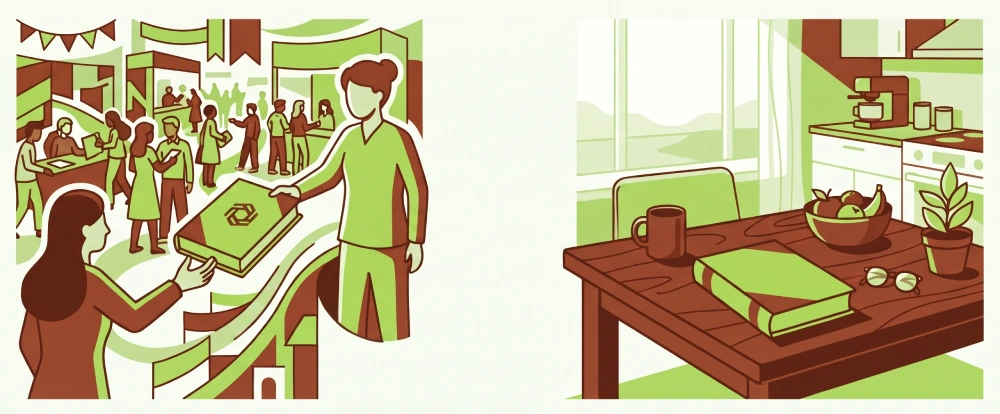
A viewbook picked up at a Delhi education fair rarely gets read cover to cover on the spot. More often, it gets carried home, left on a table where extended family members flip through it over the following days, and becomes a reference point in conversations the student isn’t even present for. A well-designed viewbook is built for that second life — the one that happens after the fair, without the institution’s staff in the room to answer questions.
Why Print Still Outperforms on Trust
There’s a well-documented psychological effect behind this: physical materials are generally processed as more credible and more permanent than digital content, partly because production and distribution carry a visible cost that a webpage doesn’t. An institution that invests in a well-produced printed piece is, whether deliberately or not, signaling a level of investment and permanence that a landing page can’t replicate — and in a decision as high-stakes as international enrollment, that signal carries weight with risk-averse families.
This effect is amplified, not diminished, in markets where a paid education agent is part of the decision. Agents build their own credibility partly on the materials they can put in front of a family, and a strong printed viewbook becomes something the agent uses on the institution’s behalf in conversations the institution itself never sees.
Where Print Falls Short — and Why That's Fine
None of this means print should carry the whole recruitment funnel. Print is poor at answering fast-changing questions — a printed tuition figure can be outdated within a year, and a printed deadline can’t be updated after a fair season begins. It’s also weak on measurement; there’s no clean way to know how many family conversations a viewbook actually influenced.
The realistic view is that print and digital aren’t competing for the same job. Digital carries the awareness and fast-fact stages of the funnel; print carries the consideration and trust-building stage, particularly once a family is already engaged enough to be having a multi-person conversation about the decision. Budgeting print against digital’s metrics — and finding it lacking — is comparing a tool built for one job against a scorecard built for another, a mismatch covered in more depth in Hue’s channel comparison guide.
What Makes a Viewbook Worth Keeping
Not every printed viewbook earns its second life. The ones that do tend to share a few traits: they’re built to be picked up and set down across multiple sittings rather than read start to finish, they lead with the questions a parent asks rather than only the ones a student asks, and they hold up physically after being carried in a bag for two weeks of fair travel. Design and production choices — paper stock, binding, finish — aren’t cosmetic decisions here; they’re part of whether the piece survives to have influence weeks after the fair ends.
There’s also a sequencing question worth getting right: the first two spreads of a viewbook get disproportionately more attention than everything after them, simply because that’s as far as most people get in a first pass. Institutions that lead with campus glamour shots in that opening spread are spending their strongest real estate on the thing a website already does well. Leading instead with outcomes — graduate employment, visa support, cost transparency — uses that opening attention on the questions a skeptical parent actually has.
The Cost of Getting This Wrong
A viewbook that doesn’t survive its second life isn’t just a wasted design effort — it’s a wasted production and shipping cost. Given that landed cost for printed materials in South Asia typically runs well above the print quote alone once freight, customs, and warehousing are included, a viewbook that gets glanced at once and discarded is an expensive way to generate a single impression. The same budget, spent on a piece designed to be revisited, does measurably more work per dollar without costing more to produce or ship.
Before finalizing a viewbook run, it’s worth asking a simple question that has nothing to do with design aesthetics: if this were left on a kitchen table for two weeks with no one from the institution present to explain it, would it still make the case on its own? A piece that depends on a staff member narrating it at the booth to make sense is optimized for the handoff moment only. A piece that can stand on its own — answering cost, outcomes, and next steps clearly without narration — is built for the conversation that happens after the fair, which is where most of a viewbook’s real influence occurs.
The Pattern Behind All Seven
Each of these mistakes has a different symptom, but the same root cause: the budget is built once, against assumptions, and then largely left alone until the numbers come in at year-end. The fix isn’t a bigger budget — it’s a handful of checkpoints built into the calendar itself: a landed-cost check before print is finalized, a quarterly agent review, a protected follow-up line item, and a contingency fund that’s actually held back rather than quietly spent.
None of these checkpoints require new headcount or new software — most can be built as recurring calendar entries against an existing budget spreadsheet. The value isn’t in the sophistication of the fix; it’s in making sure the check actually happens on schedule, rather than only when a number looks obviously wrong after the fact.
Frequently Asked Questions
Is print marketing still worth the budget in a digital-first recruitment strategy?
Yes, particularly in markets where the enrollment decision is made by a family committee rather than the student alone. Print performs a trust-building and consideration-stage job that digital content isn’t well suited to, rather than competing directly with digital for the same role.
Do students actually read printed viewbooks?
Often not cover-to-cover at the point of handoff — but the viewbook’s influence tends to happen later, when it’s revisited by the student’s family or referenced in a follow-up conversation with an agent, rather than in the initial moment it’s received.
How is a printed viewbook's ROI measured if it can't be tracked like a digital ad?
Directly, it’s difficult — but indirectly, tracking fair-to-application conversion for prospects who received a viewbook against those who didn’t (where fair data allows this split) gives a usable proxy, even without page-by-page engagement data.
Should every prospective student get a full printed viewbook, or just a summary piece?
Many institutions find a tiered approach works best: a lighter leave-behind for general fair traffic, reserving the full viewbook for prospects who’ve had a substantive conversation at the booth — which also reduces the print volume, and therefore the landed cost, without losing influence with the audience most likely to apply.
Closing Thought
The question isn’t whether print still works in a digital-first recruitment landscape — it’s whether the printed piece is being designed and budgeted for the job it’s actually doing now: surviving the trip home and holding up under a family’s scrutiny, rather than competing with a website for the same fast-answer role. The next article in this series looks specifically at what separates a viewbook built for that second life from one that gets left at the booth.