Introduction
Every August, the same conversation happens in recruitment offices across Melbourne, Toronto, Manchester, and Boston: next year’s South Asia recruitment budget lands on a spreadsheet, and someone has to decide how much goes to Google Ads, how much to education fairs in Delhi and Dhaka, how much to agent co-marketing, and how much — if any — to print.
The number itself is rarely the hard part. Universities recruiting from South Asia typically commit between 8% and 15% of their total international recruitment marketing spend to the region, depending on how central it is to their enrollment targets. The hard part is what happens after the number is set — because most of that budget gets allocated by habit, not by evidence.
This guide is a framework for changing that. It walks through where South Asia recruitment budgets actually go, the three allocation mistakes that quietly waste the most money, and a channel-by-channel approach to building a mix that reflects how South Asian students and families actually make enrollment decisions — not how a generic global template assumes they do.
🎯 Hue Insight “Universities often compare vendors on price per brochure. In reality, printing is usually only a fraction of total recruitment cost — shipping, customs, inventory, and emergency reprints add far more. Evaluating the full recruitment supply chain is where the real savings are found..”
The framework below isn’t theoretical. It’s built from the pattern that shows up repeatedly across recruitment offices working South Asia as a growth market: the same three allocation mistakes, the same under-funded funnel stage, and the same relief once the budget is rebuilt around funnel logic instead of last year’s spreadsheet. If you recognize your own budget in the mistakes section further down, that’s the point — it’s meant to be a mirror, not a hypothetical.
Why South Asia Needs Its Own Budget Logic
It’s common for international offices to build one global marketing budget template and apply it, with minor tweaks, across every recruitment region. That approach breaks down in South Asia for three structural reasons.
Committee decision
In most South Asian markets — India, Bangladesh, Nepal, Sri Lanka, Pakistan — the enrollment decision typically involves parents, extended family, and often a paid education agent or consultant, in addition to the student. A budget built around student-facing digital ads alone under-serves the influencers who actually approve the spend on tuition and travel.
Fair-first discovery
In most South Asian markets — India, Bangladesh, Nepal, Sri Lanka, Pakistan — the enrollment decision typically involves parents, extended family, and often a paid education agent or consultant, in addition to the student. A budget built around student-facing digital ads alone under-serves the influencers who actually approve the spend on tuition and travel.
Print as credibility artifact
A viewbook or prospectus handed out at a Mumbai fair is frequently photographed, re-shared in WhatsApp family groups, and referenced weeks later in a follow-up conversation with an agent. Print in this market functions less like a takeaway and more like a portable credibility artifact — which changes how it should be budgeted and produced.
Not one market
Treating 'South Asia' as a single budget line is itself a simplification worth challenging. Urban India — particularly Delhi NCR, Mumbai, Bangalore, and Chennai — behaves closer to a digitally mature recruitment market, with strong organic search intent and growing direct-application behavior. Tier 2 and Tier 3 Indian cities, along with Bangladesh, Nepal, and Sri Lanka, remain considerably more fair- and agent-dependent. A single blended budget often ends up over-serving the sub-market that's easiest to measure and under-serving the one that's actually generating the volume. This doesn't mean building five separate budgets. It means tagging spend by sub-market inside the same plan, so a Tier 1-heavy digital campaign doesn't quietly starve fair presence in the cities where fairs are still doing most of the work.
1. Decisions are made by committee, not by the applicant
In most South Asian markets — India, Bangladesh, Nepal, Sri Lanka, Pakistan — the enrollment decision typically involves parents, extended family, and often a paid education agent or consultant, in addition to the student. A budget built around student-facing digital ads alone under-serves the influencers who actually approve the spend on tuition and travel.
2. Education fairs still carry outsized weight
Fairs run by IDP, QS, and regional consultancies remain a primary discovery channel in Tier 1 and Tier 2 Indian cities and across Bangladesh, in a way that’s less true in more digitally mature recruitment markets. Budgets modeled on North American or Western European digital benchmarks routinely under-fund fair presence in South Asia relative to what actually drives applications.
3. Physical materials travel further, literally and figuratively
A viewbook or prospectus handed out at a Mumbai fair is frequently photographed, re-shared in WhatsApp family groups, and referenced weeks later in a follow-up conversation with an agent. Print in this market functions less like a takeaway and more like a portable credibility artifact — which changes how it should be budgeted and produced.
4. The market isn't one market
Treating ‘South Asia’ as a single budget line is itself a simplification worth challenging. Urban India — particularly Delhi NCR, Mumbai, Bangalore, and Chennai — behaves closer to a digitally mature recruitment market, with strong organic search intent and growing direct-application behavior. Tier 2 and Tier 3 Indian cities, along with Bangladesh, Nepal, and Sri Lanka, remain considerably more fair- and agent-dependent. A single blended budget often ends up over-serving the sub-market that’s easiest to measure and under-serving the one that’s actually generating the volume.
This doesn’t mean building five separate budgets. It means tagging spend by sub-market inside the same plan, so a Tier 1-heavy digital campaign doesn’t quietly starve fair presence in the cities where fairs are still doing most of the work.
The Three Budget Mistakes That Quietly Cost the Most
It’s common for international offices to build one global marketing budget template and apply it, with minor tweaks, across every recruitment region. That approach breaks down in South Asia for three structural reasons.
Mistake 1: Budgeting for print, not for delivered print
The quoted cost of a viewbook is rarely the real cost. Once air freight, customs clearance, warehousing, and last-minute reprints for a fair that oversold its expected footfall are added, all-in landed cost for printed recruitment material can run 30–60% above the print quote alone. Teams that budget only the print line consistently blow their true materials budget by Q3.
A common version of this: a recruitment office gets a print quote of $2.10 per viewbook for a 5,000-unit run and budgets accordingly. By the time air freight to three fair cities, customs clearance, three months of warehousing ahead of fair season, and a rush reprint of 500 units after underestimating Kolkata footfall are added, the landed cost per unit is closer to $3.40 — a 62% gap between what was budgeted and what was actually spent. None of these individual costs is unreasonable on its own. The problem is that almost none of them appear on the original print quote, so almost none of them get budgeted for.
Mistake 2: Treating agent marketing as a fixed cost instead of a controllable one
Co-marketing funds paid to agents are often set once, at a flat annual figure, and never revisited against which agents are actually converting. A small number of agent partners typically drive a disproportionate share of enrollments from any given South Asian market — and continuing to fund underperforming partners at the same rate as top performers is one of the most common silent budget leaks in the entire recruitment mix.
This mistake compounds because agent relationships are also relationship-managed, not just performance-managed. It can feel awkward to cut co-marketing funding to a partner who has been cooperative and responsive, even when their enrollment numbers lag well behind a newer partner. The fix isn’t necessarily to cut ties — it’s to separate the relationship from the budget allocation, and let a quarterly conversion review (not the account manager’s personal rapport with the partner) set the number.
Mistake 3: Under-funding the 'boring' middle of the funnel
Before moving to the framework, it’s worth pressure-testing your current budget against three questions:
- Does your print or materials line item include freight, customs, and warehousing — or just the unit print cost?
- Has agent co-marketing funding been rebalanced in the last two quarters based on actual conversion data?
- Can you name the dollar amount currently allocated to following up with a warm fair lead after the fair ends?
If the honest answer to any of these is “not sure,” the framework below is built to close exactly that gap.
A quick self-check
Digital ads get the awareness-stage budget. Fairs and agents get the consideration-stage budget. But the unglamorous middle — following up with a prospect after a fair with a welcome kit, a personalized mailer, or a follow-up call script for the agent — is where South Asian applicants most often stall out between interest and application. It’s also the stage that receives the smallest line item in most budgets, despite offering some of the strongest ROI per dollar spent.
Part of why this stage gets under-funded is that it’s the hardest to attribute credit to. A fair booth has a clear cost and a clear attendance number; a digital ad has a clean click-through rate. A follow-up postcard sent three weeks after a fair conversation doesn’t have an equally clean metric attached to it, so it’s the first line item cut when a budget needs to shrink — even though, anecdotally, it’s often the step recruitment staff themselves point to as the one prospective students specifically mention in later conversations.
🎯 Hue Insight “A follow-up welcome kit sent within 5–7 days of a fair conversation costs a fraction of the fair itself, yet is the step most commonly cut when budgets tighten. Teams that protect this line item consistently report stronger fair-to-application conversion than teams that cut it.”
A Framework for Smarter Allocation
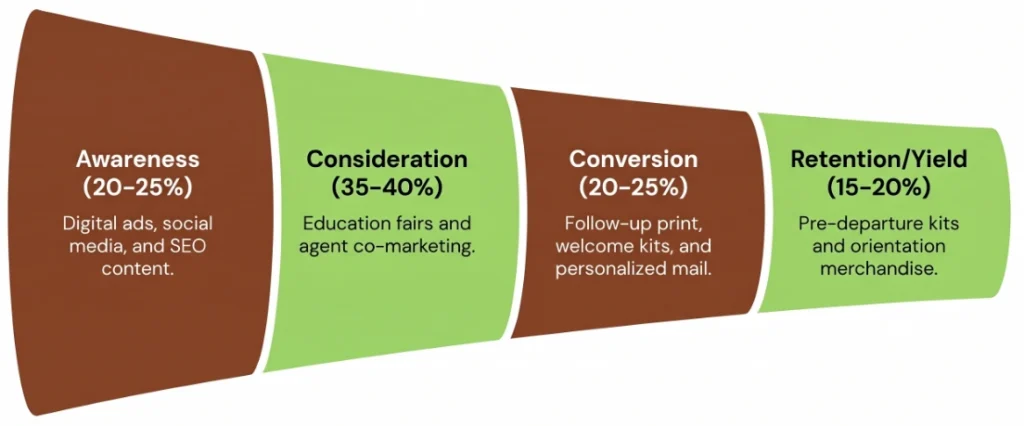
Rather than starting from ‘how much did we spend last year,’ start from the funnel stage each dollar is meant to move a prospect through. A working starting-point split for a South Asia-focused recruitment budget looks like this:
| Funnel Stage | Channel Mix | Typical Share | Primary Goal |
| Awareness | Digital ads, social, SEO content | 20–25% | Get the institution into the initial consideration set |
| Consideration | Education fairs, agent co-marketing | 35–40% | Face-to-face credibility and Q&A at the decision-influencer level |
| Conversion | Follow-up print, welcome kits, personalized mail | 20–25% | Move a warm lead to a submitted application |
| Retention / Yield | Pre-departure kits, orientation merchandise | 15–20% | Reduce summer melt after the offer is accepted |
This isn’t a universal formula — an institution recruiting primarily through agents in Bangladesh will weight differently than one running a direct digital campaign into Tier 1 Indian metros. But structuring the budget by funnel stage, rather than by channel habit, makes it possible to ask a much more useful question than ‘should we spend more on print or digital’: it becomes ‘is our conversion stage under-funded relative to how many warm leads we’re generating at the consideration stage.’
Worked Example: A Mid-Sized University's South Asia Budget
| Line Item | Allocation | Notes |
| Digital ads & SEO content | $38,000 | Weighted toward Tier 1 metro search and social |
| Education fairs (India, Bangladesh, Nepal) | $52,000 | Booth, travel, staffing, and booth collateral |
| Agent co-marketing | $18,000 | Reallocated quarterly based on agent conversion data |
| Print & fulfilment (viewbooks, follow-up kits) | $36,000 | Includes freight, warehousing, and on-demand reprints |
| Welcome & pre-departure kits | $26,000 | For accepted students, to reduce melt |
| Contingency / emergency reprints | $10,000 | Held back rather than spent upfront |
The line most institutions get wrong in a budget like this isn’t any single row — it’s the absence of a contingency line. Emergency reprints and rush freight for a fair that runs out of materials routinely get paid for by quietly cannibalizing next quarter’s digital budget. Building in a dedicated 5–6% contingency from the outset avoids that domino effect.
How this plays out across the year
Spread across four quarters, this budget doesn’t spend evenly — and it shouldn’t. Fair season in India and Bangladesh clusters heavily in September–November and January–March, so consideration-stage spend (fairs, agent co-marketing) should front-load into those windows, while conversion-stage spend (follow-up kits, personalized mail) lags roughly four to six weeks behind each fair cluster to match the natural decision timeline.
| Quarter | Dominant Spend | Focus |
| Q1 (Jul–Sep) | Digital ramp-up, fair prep | Building awareness ahead of fair season; booth collateral production |
| Q2 (Oct–Dec) | Fairs, agent co-marketing | Peak fair season across India and Bangladesh |
| Q3 (Jan–Mar) | Follow-up kits, conversion mail | Converting Q2 fair leads into submitted applications |
| Q4 (Apr–Jun) | Welcome kits, pre-departure | Reducing melt between offer and enrollment |
Signs your current budget needs rebalancing
- Fair attendance and lead capture are strong, but application submission rates from those leads lag behind other regions.
- More than one reprint order was placed last fair season outside the original production plan.
- Two or more agent partners haven’t had their co-marketing allocation reviewed in over six months.
- There’s no dedicated line item for the four-to-six-week follow-up window after a fair.
- Melt between accepted offers and confirmed enrollment from South Asia runs noticeably higher than from other recruitment regions.
Building the Budget: A Step-by-Step Approach
Step 1: Start with enrollment-by-channel, not spend-by-channel
Pull last year’s actual enrollments and trace each one back to the channel that first generated the lead — not the channel that received the largest share of last year’s spend. The two lists are rarely identical, and the gap between them is usually the clearest signal of where the current budget is mismatched to what’s actually converting.
Step 2: Map current spend against the four funnel stages
Using the framework above, tag every existing line item as awareness, consideration, conversion, or retention spend, and total each bucket as a percentage of the whole. Any stage sitting meaningfully under its benchmark share — particularly the conversion stage, which is the one most commonly under-funded — is a candidate for rebalancing before anything else.
Step 3: Score agent partners on conversion, not activity
Applications submitted is a weaker signal than applications enrolled. Build a simple scorecard ranking agent partners by enrollment conversion over the past two to three intakes, and let that ranking — not tenure or relationship history — drive the next round of co-marketing allocation.
Step 4: Separate print cost from landed cost in every quote
Request an all-in landed cost estimate from any print or merchandise vendor before finalizing the materials budget — including freight, customs clearance, and warehousing through the relevant fair season. A quote that only covers unit print cost isn’t a usable budgeting input on its own.
Step 5: Hold back a dedicated contingency line
Set aside 5–10% of total budget specifically for fair-season reprints and rush shipping, and treat it as untouchable for anything else. This is what prevents an emergency reprint in October from quietly eating into a digital campaign planned for January.
Step 6: Revisit the split at mid-year against conversion, not spend-to-date
A mid-year review that only checks whether each line item is on pace to spend its allocation misses the point. The more useful check is whether fair-to-application and application-to-enrollment conversion are tracking where they should be — and reallocating the second half of the budget accordingly.
Why the Execution Layer Determines Whether the Budget Actually Holds
A well-built budget can still fail in practice if the operational side behind it can’t keep pace. The three mistakes covered earlier — unbudgeted landed cost, static agent funding, and an under-resourced conversion stage — are ultimately execution problems as much as planning problems. A budget built stage-by-stage only holds up if someone is actually tracking landed cost, actually reviewing agent conversion quarterly, and actually has follow-up materials ready to ship within days of a fair, not weeks.
This is where a lot of otherwise well-designed budgets quietly drift back into the same three mistakes by Q3: the team that built the plan doesn’t have the operational bandwidth or the vendor relationships to execute it at the pace South Asia’s fair calendar demands. Landed cost creeps back in because nobody is tracking freight and warehousing against the print quote in real time. Follow-up kits ship late because reprint decisions get made after a fair ends rather than before it starts.
The practical fix isn’t a bigger internal team — it’s treating fulfilment and logistics as part of the budget conversation from the start, not as a downstream execution detail. A single point of accountability for landed cost, reprint decisions, and shipment timing to each fair market removes the gap between what the budget assumes and what actually happens on the ground in Delhi, Dhaka, or Colombo.
Frequently Asked Questions
How much should a university spend on South Asia recruitment marketing?
Most institutions treating South Asia as a strategic priority allocate 8–15% of total international recruitment marketing budget to the region, though this varies significantly by how central South Asian enrollment is to overall international targets.
Is print still worth budgeting for in South Asia recruitment?
Yes, but it should be budgeted at landed cost — including freight, customs, and warehousing — rather than print cost alone. In fair-heavy markets like India and Bangladesh, print materials still function as a key credibility artifact that gets shared beyond the initial handoff.
What's the biggest budget mistake universities make in this region?
Under-funding the conversion stage — the follow-up materials and outreach between a fair conversation and a submitted application — relative to how much is spent generating that initial fair conversation in the first place.
How often should agent co-marketing budgets be reviewed?
Quarterly, against actual enrollment conversion by agent, rather than annually against a flat commitment. Conversion performance among agent partners typically varies enough that annual reviews leave underperforming allocations in place for too long.
Should the budget be split evenly across India, Bangladesh, Nepal, and Sri Lanka?
No — an even split usually mismatches actual enrollment volume by sub-market. It’s more effective to weight allocation toward each market’s contribution to current and target enrollment, while tagging spend by sub-market inside a single plan so digitally mature cities like Bangalore or Delhi NCR don’t crowd out fair- and agent-dependent markets that are still driving the bulk of applications.
What percentage should be held back as contingency?
A contingency of 5–10% of the total South Asia budget, held back specifically for fair-season reprints and rush freight, is enough to absorb most emergency costs without cannibalizing the following quarter’s planned spend.
Plug in your total South Asia budget and this planner splits it across the four funnel stages above, flags stages that are under-funded relative to benchmark, and separates quoted print cost from landed cost automatically.
Closing Thought
The universities getting the most out of their South Asia recruitment budget aren’t necessarily spending more than their peers — they’re spending against the funnel stage that’s actually under-performing, rather than the channel that’s easiest to measure. A budget built stage-by-stage, with landed cost and agent performance built in from the start, tends to outperform a bigger budget built on habit.
This is the first article in Hue’s Recruitment Budget & Marketing series. The next explores how to weigh digital, fairs, print, merchandise, and agent marketing against each other directly when planning next year’s channel mix